Gustavo González López, from key man of Chavista espionage to Venezuela’s defense minister
The new official is a military officer with extensive experience in espionage services and loyal to the political objectives of the Bolivarian revolution
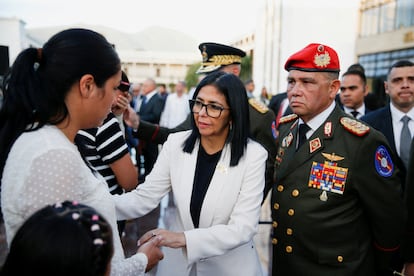
Venezuela’s new Minister of Defense, Major General Gustavo González López, is another military officer who years ago became a revolutionary figure and part of the inner circle of power in the Chavista regime. He has been close, both politically and personally, to Nicolás Maduro and also maintains a clear affinity with the acting president, Delcy Rodríguez. Throughout his career, he has also been valued within the regime’s hierarchy as one of Diosdado Cabello’s most loyal men. With this appointment, González López—who already held important positions—becomes a particularly powerful figure within the government’s command structure.
Three days after the U.S. military operation that captured Maduro and his wife, Cilia Flores, González López was appointed by Rodríguez as commander of the Presidential Honor Guard regiment, a corps comprised of the regime’s most loyal officers. The Guard was attacked with particular force by U.S. forces in the early hours of the operation, suffering approximately 30 casualties.
González López is, above all, a military officer with extensive experience in the intelligence services of Chavismo, where he spent most of his career within the Bolivarian government. He speaks little and, according to those who know him, works hard and demands a great deal. He was commander of the Bolivarian Militia in 2011. During the most turbulent times of the Maduro government, he served as Minister of the Interior, Justice, and Peace. He was the director of the General Directorate of Military Counterintelligence (DGCIM), a position he had previously held. He also headed the Bolivarian Intelligence Service (SEBIN) on two occasions (2015-2018 and 2019-2024).
González López was briefly dismissed from the SEBIN in 2018 following the scandal surrounding the death of Primero Justicia councilman Fernando Albán, who, after being detained upon returning to the country, fell from the 10th floor of the political police headquarters days later. His death, officially presented as a suicide, was denounced by the opposition as an assassination.
Following this episode, which had political repercussions for Maduro, González López was replaced by Christopher Figuera, a military officer who was later implicated in a conspiracy to facilitate the escape of opposition leader Leopoldo López and overthrow the government. Figuera broke with the regime in 2019. Shortly afterward, Maduro reinstated González López, seeking to ensure loyalty in a particularly sensitive position.
Born in 1960 in Carrizal, a mountainous town near Caracas, Gustavo González López graduated from the Venezuelan Military Academy in 1982. In 1991, during the administration of Carlos Andrés Pérez, he was sent to the School of the Americas at Fort Benning, Georgia for advanced training and psychological operations. He joined Hugo Chávez’s inner circle in 2006, a period in which, while still an active-duty military officer, he served as general manager of the Caracas Metro, when Diosdado Cabello was Minister of Infrastructure.
Although he has never been a political actor in the strictest sense, González López belongs to a generation of officers deeply influenced by the leadership and doctrine of Hugo Chávez. He is a reserved figure, with little public exposure, who does not participate in political debate and has maintained a strictly military profile.
González López was one of the first Chavista officials sanctioned by the United States. The Obama administration accused him of allegedly undermining democracy and participating in systematic human rights violations. He has also been sanctioned by Canada, Switzerland, and Panama on similar grounds.
Considered a tough and disciplined military man, he was removed from his leadership position at SEBIN in 2024. In his farewell ceremony, broadcast nationwide, and in the presence of his superior, Vladimir Padrino, he addressed Maduro with these words: “I thank you for the trust you have placed in me to serve you these past years. The achievements of my tenure are, first and foremost, your credit. Any shortcomings I may have had are indeed my responsibility.”
Sign up for our weekly newsletter to get more English-language news coverage from EL PAÍS USA Edition